

Frequently Asked Questions (FAQs)
Published: 26 June 2026
Last Updated: 26 June 2026
- 1. What is a Local Plan?
- 2. Why does the Local Plan need to be reviewed?
- 3. What is the new Plan-making system?
- 4. Does Rossendale have a timetable for preparing the Local Plan?
- 5. Will the timetable change? And how will I know?
- 6. What has been done so far on the Local Plan?
- 7. What other work needs to be carried out to prepare the new Local Plan?
- 8. Will I get a chance to have my say on the new Local Plan?
- 9. How can I be kept informed?
- 10. What impact will Local Government Reorganisation (LGR) have on the new Local Plan?
- 11. What is the National Planning Policy Framework (NPPF)?
- 12. How would the proposed changes in the draft National Planning Policy Framework (NPPF) impact the new Local Plan?
- 13. What impacts will the new NPPF have on the existing policies in our Local Plan?
- 14. What will happen to Supplementary Planning Documents?
- 15. What is the Spatial Development Strategy (SDS)?
If you have any other questions about the Local Plan – please email forwardplanning@rossendalebc.gov.uk or write to Forward Planning, The Business Centre, Futures Park, Bacup, OL13 0BB.
THE LOCAL PLAN
A Local Plan provides a vision for the future development of a local area. It allocates land for development and protection. It includes planning policies, which are used to determine planning applications. The Plan is accompanied by a Policies Map, which shows the policies and allocations.
The Local Plan is drawn up by the local planning authority in consultation with the community and other stakeholders, including land owners, infrastructure providers and statutory consultees, under the Town and Country Planning (Local Planning) (England) Regulations 2026.
Every local planning authority must produce a local plan and keep it up-to-date.
The Rossendale Local Plan 2019 – 2036 was adopted on 15 December 2021. Government legislation means it must be reviewed every 5 years to take account of any changes in national planning policy, and there have also been changes to how Local Plans should be prepared.
Since the Local Plan was adopted there have been significant changes introduced that must be taken into account. There are:
- changes to how Local Plans should be prepared
- changes to national government planning policy
- introduction of Supplementary Plans.
Updating the Local Plan will help us to plan for the higher housing requirement that has been introduced by the Government to meet housing need, and ensure access to open space and other key community infrastructure, including schools. It will help us to respond to climate change, protect the natural environment, improve biodiversity, and ensure developments are well designed.
THE NEW PLAN-MAKING SYSTEM
The Government has introduced a new system for Plan-making so that plans will be shorter, clearer and faster to prepare.
The new Local Plan must be prepared in a 30-month period starting October 2026.
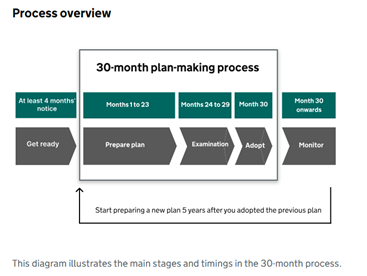
The Council must give notice of its intention to start preparing a new Local Plan, and at the same time, must publish a timetable. These timetables must be kept live and updated monthly.
Rossendale’s Local Plan timetable can be viewed here: Local Plan Timetable
The Council will aim to keep to the timetable. The Council must ensure the timetable is up-to-date. Any changes will be published on the website, with all amendments to the timetable recorded.
The Council issued the Local Plan Timetable and Notice of Intention to commence a Local Plan on 11 May 2026.
The Council issued the Local Plan Scoping consultation on 15 June. This will run until 27 July 2026.
A Call for Sites is expected to be issued in summer 2026, asking stakeholders about land that may be suitable for development, or protection.
The key steps that we will be carrying out under the new system are as follows.
- Evidence gathering (this is ongoing)
- Undertake a second public consultation for 6-weeks when residents and other interested parties will be able to view the draft Local Plan and have their say on the draft vision, proposed spatial strategy and a summary of evidence gathered to date (May/June 2027).
- Preparing the Local Plan
- Undertaking a further 8-week public consultation (June/July 2028)
- If no major changes are needed, the plan will be finalised and submitted to the Secretary of State for examination in public by an independent planning inspector (October 2028)
- Examination including hearing sessions (Late 2028/early 2029)
- Adoption of the Local Plan by the Council (April 2029).
Yes. The Local Plan timetable indicates when we expect to undertake public consultation on the new Local Plan. Further information about how we intend to keep everyone informed and how we propose to consult is set out in the emerging Engagement Strategy.
We will contact everyone on our consultation database to let them know when the consultation period begins. We will also engage with the media and other interested parties.
We will keep the web pages up-to-date with regular updates about progress.
We will also be holding public consultations as we prepare the Local Plan.
If you would like to be kept informed, please sign up to our mailing list.
The Government intends to simplify the current structure across Lancashire, replacing the current 2-tier system of Lancashire County Council and 15 district councils, creating several new unitary councils that will provide all local services, including education and social care. The aim is to make services work better for residents and businesses.
We expect the final proposals for LGR in Lancashire will be published in summer 2026.
Government has stated that it expects all councils to progress promptly with preparing new Local Plans and that LGR should not be used as a reason to delay.
We have started early, preparatory work on our new Local Plan in order to be in the best position possible once we know the new structure of the Council. In the mean-time officers and members are liaising with neighbouring authorities, sharing information, knowledge and experience.
CHANGES TO THE NPPF
The NPPF sets out the Government's planning policies for England and how these should be applied. We need to take the policies in the NPPF into account when preparing Local Plans and making decisions on planning applications.
The Government published an updated draft NPPF in December 2025 for consultation. It is a significant change to the previous NPPF in both structure and content. Once published, the new NPPF will need to be used when preparing the new Local Plan and in all decisions that we make on planning applications.
One of the key changes proposed in the draft NPPF is to split out the plan-making policies and decision-making policies. In doing so, the Government has created a comprehensive and detailed set of decision-making policies that cover many of the policy areas that our Local Plan does - in particular the Local Plan: Development Management Policies.
The aim is to create a consistent approach across the country and remove the need for individual Local Plans to repeat these generic policies. This is intended to help to speed up the plan-making process as new Local Plans will only be able to include locally specific policies and site allocations. The draft NPPF states that new Local Plans must not repeat or modify the national decision-making policies.
The NPPF is still in draft form, so currently does not have any impact on our Local Plan policies or decisions on planning applications. However, once it is finalised it will be become a material consideration when deciding planning applications. The draft NPPF states that any existing Local Plan policies which are in any way inconsistent with the national decision-making policies should be given very limited weight. This is likely to mean that some of our existing policies will no longer be able to be used as they currently are.
SUPPLEMENTARY PLANS
Under the reforms to the plan-making system, Supplementary Planning Documents (SPDs) will not be able to be brought forward as of 30 June 2026. All existing SPDs will continue to have weight until the new Local Plan is adopted. SPDs will be replaced by Supplementary Plans. Unlike SPDs, which were advisory and interpreted existing local plan policies, SPs will formally be part of the development plan, and will undergo independent examination, giving them greater influence in planning decisions
THE SPATIAL DEVELOPMENT PLAN
A new duty, brought forward through the Planning and Infrastructure Act 2025 requires all strategic authorities, such as the Lancashire Combined County Authority (LCCA), to prepare a Spatial Development Strategy (SDS) for their area. The Lancashire SDS will form part of the statutory development plan for the area.
The SDS is expected to set a clear spatial framework for investment and growth, addressing key cross-boundary spatial issues. The SDS should remain strategic in nature but is expected to include the following:
- setting and distributing housing need figures
- enabling the delivery of strategic infrastructure
- supporting economic growth, and
- improving climate resilience.
Local Plans will need to be brought forward in conformity with the SDS, and this will be tested at Local Plan Examinations in Public.